
What Happens During Professional Air Duct Cleaning?

Duct Cleaning, Dryer Vent & Chimney Services in Tulsa
What Actually Happens When a Pro Cleans Your Ducts
Professional air duct cleaning is a multi-step process, not a quick pass with a vacuum. A trained technician will inspect your system, set up containment equipment, run specialized tools through each branch of ductwork, clean the components connected to it, and then verify airflow before wrapping up. Here’s what actually happens from the moment the crew arrives to the moment they leave your Owasso or Tulsa home.

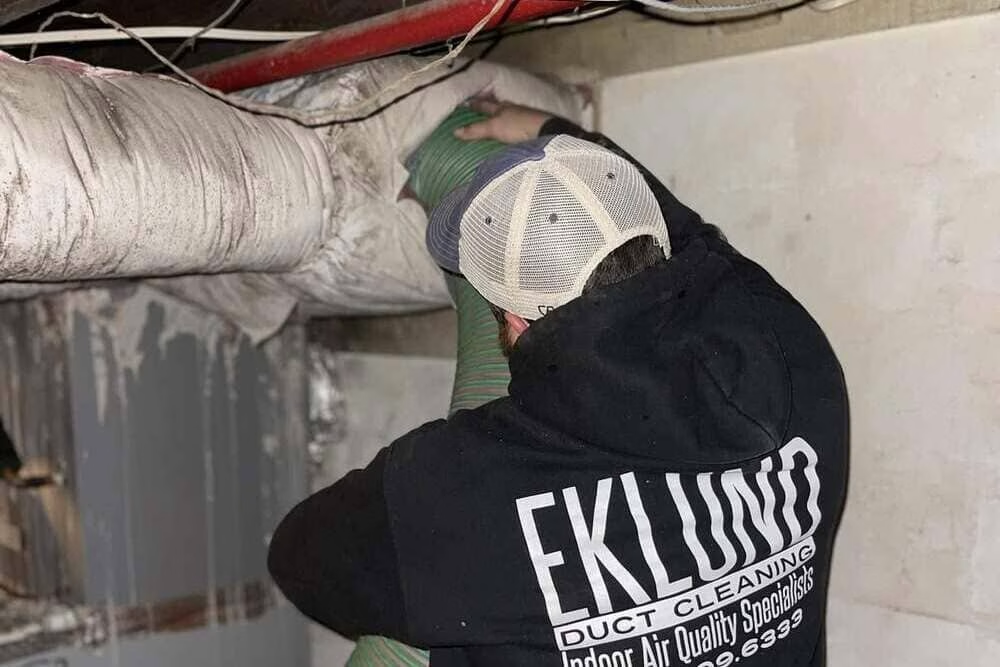
The Short Version — 7 Steps a Real Duct Cleaning Job Includes
Most reputable duct cleaning services follow a similar sequence, even though the equipment and specific techniques vary. Here’s the sequence:
- Pre-inspection — walkthrough with you and a look at vents, returns, and the air handler
- Protection and setup — floor coverings, corner guards, and containment barriers
- Negative air pressure — a large HEPA vacuum connected to the main trunk line pulls debris toward it
- Agitation — compressed air whips, brushes, or air skippers knock debris loose inside each branch
- Component cleaning — blower motor, coil, drip pan, and housing cleaned if accessible
- Sanitizing (optional) — some jobs include an EPA-registered sanitizer or deodorizer
- Post-inspection and airflow check — verify the system was reassembled properly and airflow is restored
That’s the outline. The rest of this page breaks down what each step actually looks like in your home.
Before the Truck Even Arrives
Most of the process happens in your house, but a few things happen before that matter to the outcome.
Confirming scope and access
A good company will confirm what you’re having cleaned — supply ducts, return ducts, both, or vents only. They’ll also ask about pets, anyone with respiratory sensitivity, and whether there’s a basement or crawlspace involved.
Scheduling around your household
If someone in the home has asthma or allergies, it’s usually worth scheduling when they’ll be out for a few hours. The process is designed to contain dust, but minor airborne debris can stir up temporarily.
Your prep list
- Clear small items off floor areas near vents and the air handler
- Secure pets in a room that won’t be serviced or off-site for the day
- Move furniture a few feet away from vents if possible
- Have your HVAC filter handy if you want it replaced after the job
Nothing extreme — this is a low-disruption service.
Step 1 — Pre-Inspection and Walkthrough
The technician starts by walking the property with you. They’re looking for a few specific things:
- Visible signs of buildup at registers and return grilles
- Mold, moisture, or pest activity that changes the plan
- Ductwork material (flex, rigid metal, fiberboard) and the tooling needed
- Access points for the vacuum and agitation equipment
- Filter condition and whether the system has been running on a dirty filter
If the inspection turns up anything unusual — like visible microbial growth or disconnected duct sections — a good technician will tell you before starting so you can decide how to proceed.
Step 2 — Setting Up Protection and Containment
This is where professional service separates from a DIY shop-vac job.
What gets protected
- Floors and carpeted paths with drop cloths or runners
- Corners and doorframes with guards
- Nearby furniture with plastic sheeting
What gets contained
A negative air machine (a large HEPA vacuum) connects to a cut point in the main trunk line. Because it pulls air toward itself, dust that gets knocked loose is pulled into the vacuum instead of drifting into your living space. When setup is done right, this is the single biggest reason professional cleaning stays clean inside your home.
Step 3 — The Actual Cleaning: Agitation and Extraction
Two things happen at the same time during the main cleaning phase:
Extraction
The HEPA vacuum maintains suction on the trunk line, creating continuous negative pressure.
Agitation
The technician works each supply run from the register end toward the trunk. Depending on the duct material and the buildup, they may use:
- Air whips — compressed air lines that spin inside the duct, flinging debris loose
- Rotary brushes — soft nylon brushes sized for the duct’s diameter
- Air skippers — compressed-air nozzles that push debris forward in a controlled stream
- Manual tools — for tight runs, transitions, and short branches
Each register gets covered or resealed as the technician finishes that branch, so debris from one run doesn’t drift into another.
Step 4 — Cleaning Connected Components
Ducts don’t operate in isolation. A complete job usually touches these adjacent parts:
- Registers and return grilles — removed and washed, then reinstalled
- Blower motor housing — vacuumed and wiped down if accessible
- Evaporator coil — externally cleaned if it’s in the air handler (coil cleaning is separate work if it’s heavily fouled)
- Drip pan — vacuumed out and checked for standing water
- Filter slot and housing — cleaned so a new filter seats correctly
These steps are what separate a “duct vacuuming” from actual duct cleaning.
Step 5 — Optional Add-Ons You Might Be Offered
Different companies offer different extras. Common ones include:
- EPA-registered sanitizer applied to the duct interior after cleaning
- Deodorizer for homes with lingering pet or smoke odors
- Dryer vent inspection while the equipment is already set up
- Chimney inspection if you have a fireplace
These aren’t required. A reputable company will explain what each does and let you decide.
Step 6 — Post-Job Verification
Before the technician packs up:
- All access holes cut during service are sealed
- Registers and grilles are back in place
- The HVAC system is powered back on
- Airflow is checked at multiple supply vents
- A visual or camera check confirms the trunk line is clear
What you should ask before they leave:
- “Can I see before-and-after photos of the trunk line?”
- “Did you find anything that needs a follow-up?”
A company confident in its work will happily answer.
What This Means for Your Home
Three practical takeaways:
1. It’s less disruptive than most homeowners expect. Typical single-family home jobs take 2 to 4 hours. You don’t need to leave. If someone in the home has respiratory sensitivity, scheduling them out for the morning is a reasonable precaution.
2. The job is only as good as the containment. If a company shows up without HEPA equipment or a negative air machine, walk away. The whole point is to remove debris, not redistribute it.
3. Access matters more than size. A 1,500-square-foot home with inaccessible duct runs can take longer than a 2,500-square-foot home with a basement and clear access. Ask for a time estimate when you book.
When to Call a Professional
You should call a professional duct cleaning company when:
- You’re not sure whether your ducts need cleaning and want an honest assessment
- You’ve noticed visible dust puffs, musty odors, or pest activity around vents
- You’ve had a renovation, water damage, or pest issue
- Someone in your household has ongoing respiratory concerns
- You’re buying a home and want to know what you’re inheriting
For commercial properties — offices, restaurants, clinics — the process is similar but usually scheduled around business hours and coordinated with property management.
How Eklund Duct Cleaning Runs This Process
Eklund Duct Cleaning serves homeowners and businesses throughout the Tulsa area with professional air duct cleaning, dryer vent cleaning, and chimney cleaning. The team brings HVAC background and containment equipment to each job, and customers describe the crew as tidy, punctual, and thorough.
If you’re unsure whether your ducts actually need cleaning, Eklund Duct Cleaning offers free project estimates. That’s a chance to get a professional assessment without committing to work you may not need yet.
For commercial properties, Eklund also handles commercial air duct cleaning and commercial dryer vent cleaning, with scheduling designed to fit around business operations.
Serving Owasso, Tulsa, and the Surrounding Communities
Eklund Duct Cleaning is based in Owasso, Oklahoma, at 308 E 5th Ave — the north side of the Tulsa metro, easy to reach from most of the surrounding suburbs.
The team serves homeowners and businesses in Tulsa, Broken Arrow, Claremore, Bixby, Jenks, Collinsville, Catoosa, Sand Springs, Sapulpa, Skiatook, and Glenpool. If you’re anywhere in the Tulsa metro and not sure whether you’re in the service area, call and ask — most of the metro is covered.
Common Questions About the Process
How long does professional air duct cleaning take?
Most single-family homes take 2 to 4 hours, depending on the number of vents, duct accessibility, and buildup level. Larger homes, commercial properties, or jobs with crawlspace or attic access can run longer. Ask for a time estimate when you schedule so you can plan your day.
Do I need to be home during the appointment?
You don’t need to stay for the entire job, but you should be there at the start for the walkthrough and at the end for the final inspection. If you have pets or someone with respiratory sensitivity, scheduling them out of the house during the cleaning hours is a good idea.
Will duct cleaning make a mess in my house?
A properly run job won’t. Reputable companies use HEPA vacuums, containment barriers, and floor protection. If a company shows up without this equipment, that’s a red flag — the whole point is to keep debris out of your living space, not stir it up.
How do I know the job was done properly?
Ask to see before-and-after photos of the trunk line, confirm all access points are sealed, and check that airflow at your supply vents feels normal or improved. A technician confident in the work will walk you through what they did and answer questions.
Can you clean ducts in a home with pets?
Yes. Pets just mean more debris typically, which is why homes with shedding pets often need more frequent cleaning. Secure pets in a room away from work areas or off-site during the appointment for their comfort and the crew’s safety.
Client Reviews


If you’re in Owasso, Tulsa, or anywhere in the surrounding area and you want to know exactly what a duct cleaning would involve for your home, Eklund Duct Cleaning offers free estimates. Call or contact the team to schedule an assessment — no obligation, no pressure, just a clear look at what your system actually needs.